The One Supplement I Take for Skin and Joints, the Organ That Predicts Brain Health & a Beginner's Guide to Peptides
This is our digest of Dan Go's weekly 4 Minute Fridays newsletter — cutting-edge tips to get lean, boost energy, and live longer.
In this issue:
- One supplement Dan takes daily for his skin and joints
- The organ that predicts your brain's future
- A beginner's guide to peptides
Dan opens this week with a story from the barbershop: while getting a haircut, a 98-year-old man walked in, and Dan couldn't resist asking his secret. The answer, delivered with a big gap-toothed smile: "Scotch." It reminded him of a centenarian he once met on Hawaii's North Shore, happily drinking margaritas and eating tacos. Dan isn't telling you to start drinking more — but the centenarians he's met share something in common: they weren't chasing optimization, didn't know what VO2max was, and were happy, smiling, and low-stress. Something to think about on our own quest for longevity.
Sponsor: This issue is brought to you by AG1 — Dan takes it daily to cover his nutritional bases when life gets busy, and reports better energy, smoother digestion, and sharper focus. AG1 Next Gen has 4 gold-standard clinical trials behind it showing it fills nutrient gaps, supports gut health, and improves key nutrient levels over 3 months. New subscribers through Dan's link get a free Travel Kit, including a limited-edition travel pouch and 7 AG1 Travel Packs.
1. One supplement I take daily for my skin and joints
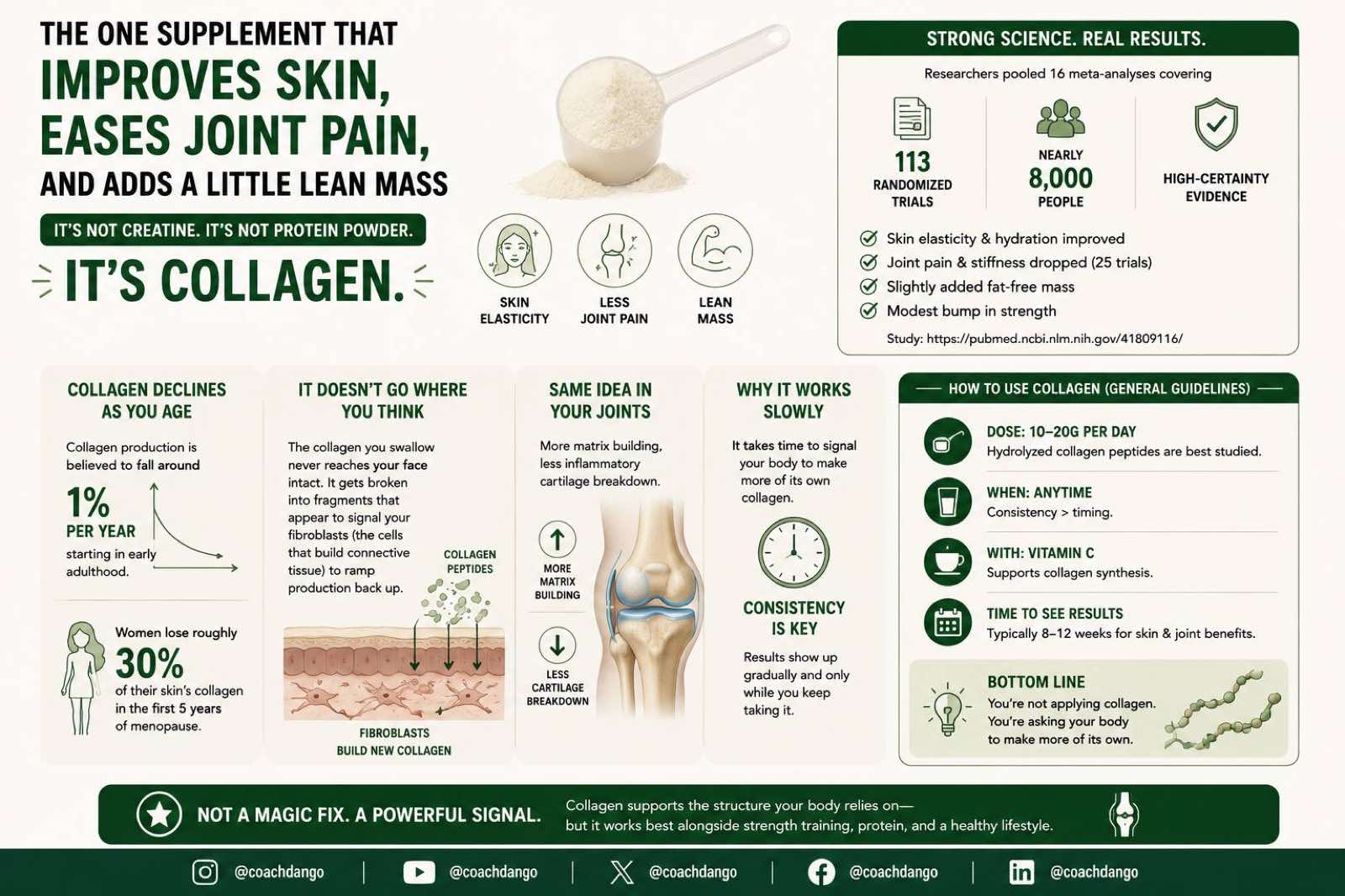
There's one supplement that improves skin elasticity, reduces joint pain, and adds a little lean mass. It's not creatine, and it's not protein powder — it's collagen.
Researchers pooled 16 meta-analyses covering 113 randomized trials and nearly 8,000 people. The findings:
- Skin elasticity and hydration both improved, with high-certainty evidence behind the result.
- Across 25 trials, joint pain and stiffness dropped.
- Supplementation was also linked to a slight increase in fat-free mass and a modest bump in strength.
Why this matters: collagen production is believed to fall around 1% per year starting in early adulthood, and women lose roughly 30% of their skin's collagen in the first five years of menopause.
Here's the mechanism Dan highlights — the collagen you swallow never reaches your face intact. It gets broken down into fragments that appear to signal your fibroblasts, the cells that build connective tissue, to ramp production back up. The same idea plays out in your joints: more matrix building, less inflammatory cartilage breakdown.
Which is why it works slowly, and only while you keep taking it. You're not applying collagen directly — you're asking your body to make more of its own.
2. The organ that predicts your brain's future
Researchers tracked 489,972 adults for a median of 13.6 years, measuring muscle mass and body fat in every one of them.
The results:
- Low muscle plus high body fat came with a 34% higher dementia risk.
- Low muscle on its own carried a 30% higher risk.
- Carrying extra fat while keeping your strength wasn't linked to higher risk at all — if anything, it leaned slightly the other way.
Muscle, not fat, was doing the protective work.
In a subgroup measured twice over time, grip strength was the real tell: when it fell, dementia risk climbed. Changes in fat mass and muscle size predicted almost nothing by comparison.
Dan's takeaway: if you're already lifting, keep going. If not, find a coach, find a community, start where you are. It's better to be the oldest person in the weight room than the youngest person in the nursing home.
❤️ Dan's favourite thing this week
Dan's favorite find this week is a video: unless you've been living under a rock, you've heard of peptides — an emerging medical technology. When they first crossed his desk, he thought it was hype; he's been in the fitness industry 20+ years and has seen plenty of trends sizzle for a season and fizzle out. This one, he says, is different.
Quite frankly, we've been taking peptides for ailments for decades — insulin is a peptide, GLP-1s are peptides. What actually changed is that GLP-1s got millions of people comfortable injecting themselves, and everything else walked through that open door.
Dan's recommendation for dipping a toe into peptide education is Dr. Andrew Huberman interviewing Dr. Abud Bakri, a friend of his. Abud is a practicing internal medicine physician, not a peptide salesman — he's candid about what we actually know versus what the internet claims, including the fact that nearly all the BPC-157 data comes from animal studies out of a single lab in Croatia. He covers sourcing, safety, the gray market, and where people are getting burned. If you've ever wanted to learn more about peptides, Dan says this is the video to start with.
Client of the week — John Niles, CEO of a law firm
John came into the program wanting to lose weight, but he walked away with much more. In just a few months he's down 38.5 lbs, lost 4 inches off his waist, and built a level of nutrition discipline — especially on weekends — that completely changed how he operates.
But the biggest shift wasn't physical. John said the program gave him the energy, focus, and clarity to deliver some of the best appellate arguments of his career during one of his most demanding weeks. Here's how they did it:
- Focused on structured eating, with a flexible but disciplined approach
- Built momentum through simple, effective workouts
- Tightened up nutrition on the weekends without sacrificing lifestyle
When your health improves, everything else levels up too. Outstanding work, John! Entrepreneurs who want the same can apply for the coaching program — capacity is almost full, so availability is limited.
One quote to finish your week strong
"Buy the ticket. Take the ride."
― A character from the show Californication
When it comes to the things you want to do or the places you want to go, Dan's philosophy is simple: buy the ticket, take the ride. When you're thinking about the things that could get in the way — especially something you've wanted for a long time — take the plunge. Buy the ticket, schedule it for yourself, and it becomes a forcing function to follow through on your dreams.
──
As promised, get healthier in under 4 minutes.
— Dan
When you're ready, here are 3 ways Dan can help:
- The Lean Body 90 System — reach your fitness goals on 90 minutes a week, without restrictive diets. 1000+ students.
- Private one-on-one coaching for entrepreneurs who want to get lean, boost energy, and get in their best shape.
- Sponsor the newsletter and reach 540,755+ subscribers.
References
- Ravindran R, Pizzol D, López-Gil JF, Rahmati M, Boyer L, Fond G, Butler L, Stellato A, Gawronska J, Barnett Y, Keyes H, Soysal P, Eren R, Onal B, Yon DK, Smith L. Collagen Supplementation for Skin and Musculoskeletal Health: An Umbrella Review of Meta-Analyses on Elasticity, Hydration, and Structural Outcomes. Aesthet Surg J Open Forum. 2026 Jan 30;8:ojag018. doi: 10.1093/asjof/ojag018. PMID: 41809116; PMCID: PMC12968778.
- Guan Z, Stephan B, Donini L, et al. Sarcopenic obesity and dementia risk: Primary associations and landmark analyses of muscle strength and body composition trajectories. Clinical Nutrition, 2026;63.
Originally published in Dan Go's 4 Minute Fridays newsletter (July 17, 2026). This content is for informational purposes only and is not medical advice. Consult your healthcare provider before starting any new wellness protocol.